Moscow’s First Trolleybus: The 1933 Route and the LK
When regular service began, where the first route ran, which factories built the LK and why opening a line required more than new vehicles.
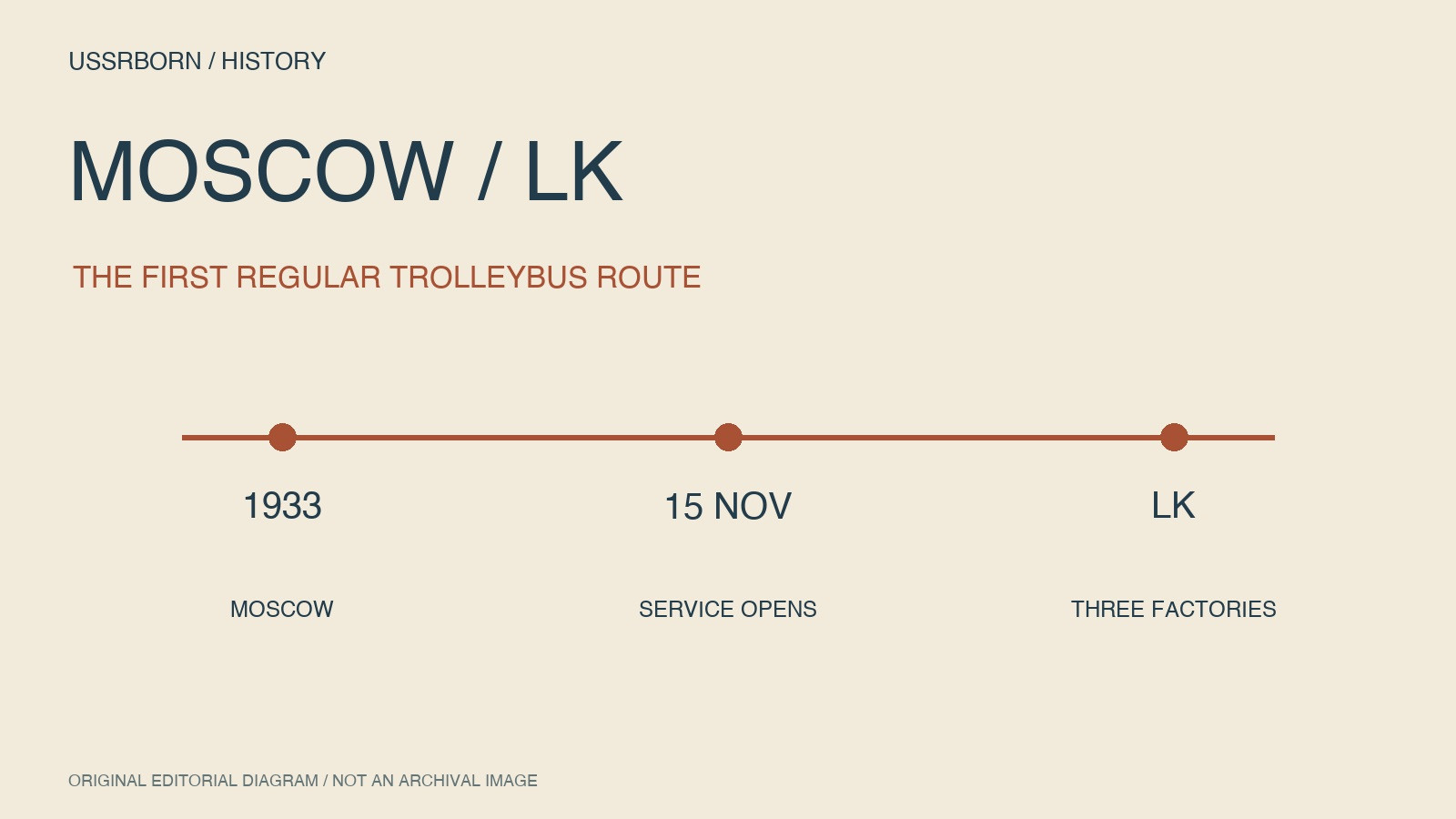
Regular trolleybus service began in Moscow on 15 November 1933. The first route ran from the Tverskaya Zastava area towards the Moscow Circular Railway along the Leningrad highway corridor. Its vehicles were LK trolleybuses, whose designation referred to Lazar Kaganovich. A modest route marked the beginning of a new form of public transport in Soviet cities.
The story is about more than an unusual vehicle. A trolleybus brought together motor manufacturing, electrical engineering and municipal operations. Building it was only part of the job. It also needed power along its route, maintenance arrangements and a service that passengers could use repeatedly.
Trials and the start of regular service
Several November dates appear in accounts of the first LK vehicles. Earlier dates concern trials or demonstration journeys, rather than the start of normal service. A photograph by Anatoly Egorov, reproduced by Moskovsky Komsomolets, is captioned as showing a journey for guests on 6 November 1933. That earlier appearance does not displace 15 November as the date of the regular opening.
The distinction matters when reading contemporary press coverage. A vehicle could be photographed on a public street and carry invited passengers before it became part of an ordinary route. For a history of engineering, those preliminary journeys are significant. For a history of passenger transport, the opening of the service answers a different question: when could the public begin using it as transport?
A route rather than a citywide network
Descriptions of the termini use slightly different geographical labels, including Tverskaya Zastava, the Circular Railway and Pokrovskoye-Streshnevo. Studies of Moscow transport commonly summarize the route as Tverskaya Zastava to Pokrovskoye-Streshnevo. These descriptions identify the northwestern corridor served by the first line; they should not be mistaken for several separate inaugural routes.
The scale of the opening is also important. A single line added a particular journey to the city's transport options. It did not make trolleybuses available in every district. To a passenger, its practical value depended on boarding points, destination and frequency, as well as connections with other services.
Dmitry Zavyalov and Nauras Suliman's retrospective study places Moscow's transport development within the growing demand for urban travel. From that perspective, the trolleybus was one way to increase the capabilities of street transport. Its first route provided a working setting in which the vehicle and the service could be developed together.
Why several factories were involved
The early LK was associated with cooperation between the Yaroslavl automobile works, Moscow's ZIS and the Dynamo electrical works. The transport museum's history identifies this combination of motor and electrical manufacturers. The model's name came from Kaganovich's initials.
That industrial partnership reflects what a trolleybus actually is. Its wheels carry it along an ordinary street, while an overhead contact network supplies electrical power. Neither the road vehicle nor the electrical equipment can explain the whole system on its own. The connection between the two is what makes the service possible.
Early vehicles also differed substantially from the later trolleybuses familiar to many readers. Wooden structural elements were used in the LK, and the museum account notes problems with protecting electrical equipment against moisture. The handsome appearance of a surviving photograph should therefore not be confused with evidence that the first design was already a mature operating standard.
A prototype can demonstrate that an arrangement works. Repeated passenger service asks a more demanding question: can it continue working under changing conditions, and can faults be repaired without seriously disrupting journeys? The first route brought those questions into everyday operation.
The municipal work behind a new vehicle
An electrically powered street vehicle depends on an infrastructure that is less conspicuous than its bodywork. The contact network defines where it can operate. Maintenance keeps the fleet available. Drivers, schedules and operating arrangements turn individual departures into a recognizable public service.
This is why the opening belongs to economic history as well as transport history. New machinery requires coordination between suppliers and the organization that uses it. The three-factory partnership helps explain production, but municipal transport management was needed to make the finished vehicles useful to the city.
The opening alone does not establish that trolleybuses were always cheaper than buses or trams. Such a comparison would require consistent evidence about infrastructure, energy, repairs, staffing and the volume of travel. A first-service date tells us when an operating system began; it cannot substitute for an assessment of its costs.
What changed in November 1933
The Moscow opening began regular trolleybus operation in the Soviet Union. Its central achievement was the move from experimental vehicles to an urban service: electric road transport now had a route on which it was expected to perform ordinary passenger work.
The event can be viewed from two directions. For industry, the LK embodied cooperation between different kinds of factory. For a passenger, it offered another way to travel along a familiar street. Holding those perspectives together makes the first trolleybus more than an anniversary image. It becomes a useful example of how a city learns to use new equipment after the inaugural journey has ended.