Pakhomova and Gorshkov: The First Olympic Ice Dance Gold
Why Pakhomova and Gorshkov’s Innsbruck victory was a first: their earlier career, Tchaikovskaya, Gorshkov’s return and how to read the results.
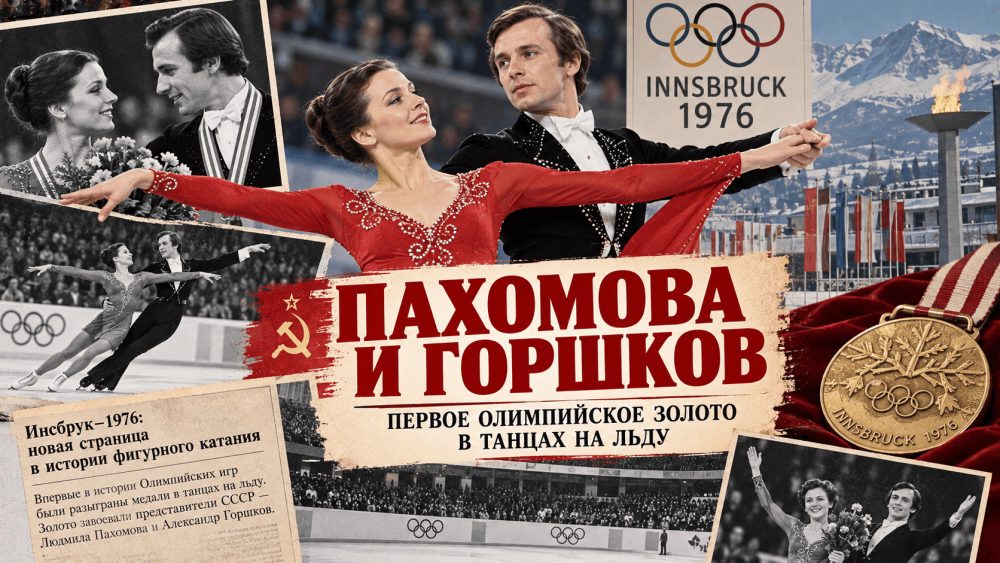
Lyudmila Pakhomova and Aleksandr Gorshkov became the first Olympic ice dance champions at Innsbruck in 1976. The word “first” needs a precise definition: these were the first Olympic medals awarded in that discipline. International ice dance competition already existed, and the Soviet couple arrived with an established competitive career behind them.
Their victory brings together a personal sporting history and a change in the Olympic programme. Keeping those histories separate helps explain why an Olympic debut could also be a crowning achievement for experienced champions.
A career before Olympic gold
Olympedia's biographical record gives Pakhomova's birth as 31 December 1946 in Moscow. Before skating with Gorshkov, she had partnered Viktor Ryzhkin. Pakhomova and Gorshkov earned international medals in 1969, followed by world titles in 1970 through 1974 and another in 1976. Those six world championships should not be confused with six Olympic gold medals.
The sequence explains their distinctive position at Innsbruck. Ice dance was new to the Olympic medal programme, but competing for international titles was already familiar work for the couple. The debut of an event and the debut of an athlete are different milestones.
A sporting biography can contain several beginnings: a first partner, a first international appearance, a first world title and a first Olympic competition. Compressing all of them into a single account of someone “starting out” erases the development that preceded the best-known achievement. In this case, the Olympic title belongs near the culmination of the competitive story, not at its beginning.
Elena Tchaikovskaya's role
Elena Tchaikovskaya coached the Olympic champions. The Russian figure skating federation's biography records both her background as a skater and her training in choreography at GITIS. That combination offers useful context for a discipline in which two performers must organise movement together rather than simply complete independent actions at the same time.
It does not, by itself, establish how every particular routine was made. A detailed history of an individual programme would require recordings, working documents or testimony from those involved. The securely documented connection is the partnership between Pakhomova, Gorshkov and their coach that led to the Olympic result.
The coach's presence also changes how we read a medal photograph. It captures the public outcome of work whose preparation happened elsewhere. Recognising that work need not mean inventing private conversations or assigning a particular idea to someone without evidence. The documented relationship is already significant.
The partnership and Gorshkov's return
In its memorial account of Gorshkov, the federation reports that he underwent a serious lung operation a year before the Games and subsequently returned to competition. That is an important fact about the run-up to Innsbruck. It is not a licence to invent a medical prognosis or details of treatment that the account does not provide.
For a dance couple, the absence of either athlete prevents the established partnership from competing. A partner's return is therefore part of the shared sporting history, not an unrelated incident in a second biography. The Olympic title should likewise be credited to both skaters, even in an article centred on Pakhomova.
Knowing the eventual result can make earlier events seem to lead inevitably towards it. They did not come with that certainty for the people involved. A careful account can recognise the significance of the return without turning uncertainty into a story of guaranteed triumph.
Innsbruck was a competition, not a single exhibition
The 1976 event included compulsory dances, an original dance and a free dance. Olympedia's final table places Pakhomova and Gorshkov first, Irina Moiseyeva and Andrey Minenkov second, and the American team of Colleen O'Connor and Jim Millns third. All nine judges ranked the winning Soviet couple first in the final result.
That last statement concerns the final classification. It does not mean that every judge made identical choices at every intermediate stage. An overall result and an individual part of a competition occupy different places in the record.
Many viewers encounter an older Olympic performance as a short recording of the free dance. Such a recording can show artistry and partnership, but it represents only part of the event. Explaining the medal requires the competition structure and final results as well. The most memorable surviving clip should not silently become a substitute for the whole tournament.
Reading historical results without false comparisons
A score printed in a 1976 table cannot simply be placed beside a modern total to establish which performance was better. A number acquires its meaning from the rules that produced it. Before comparing totals, a reader needs to know what was being assessed and how those assessments became placements.
More reliable historical questions include where a couple finished, whom they faced, which stages they had to complete and how the judges ranked them overall. Even checking whether a figure refers to a single dance or the entire event prevents misleading comparisons.
This is also why ice dance should not be casually described as pairs skating. Both involve a partnership, but the Olympic programme treats them as separate events. Pakhomova and Gorshkov's “first” belongs to ice dance. It is not a claim that no paired figure-skating performance had previously received an Olympic medal.
What one Olympic gold tells us
Pakhomova's Olympic record contains one gold medal. That is an Olympic total, not a complete measure of her career. World and European championships followed their own calendars. After competition she worked as a coach, and she died in 1986 at the age of 39.
Her historical importance is therefore not captured by counting Olympic appearances alone. The Innsbruck victory joined an accomplished partnership to a new chapter in the medal programme. Remembering both sides of that story gives the 1976 title its proper scale: one Olympic gold, earned by two athletes whose work had begun long before the discipline's Olympic medal debut.