Red Army Shoulder Boards in 1943: Decree and Transition
When shoulder boards returned to the Red Army: the January decree, Order No. 25, the February transition and clues for interpreting wartime photographs.
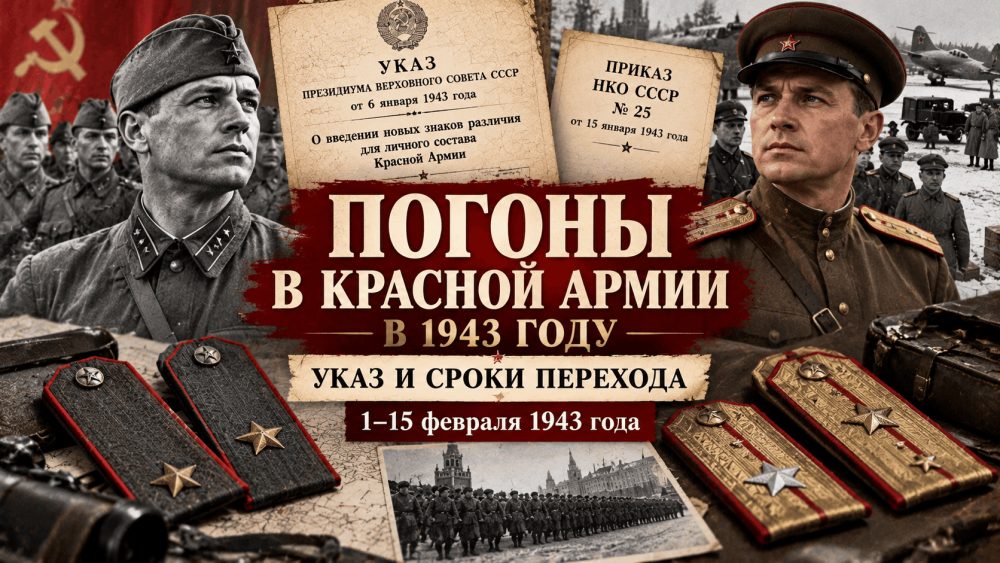
Shoulder boards returned to the Red Army under a decree dated 6 January 1943. Their introduction was a process, however, rather than a single day when every soldier changed uniform. People's Commissar of Defence Order No. 25, issued on 15 January, specified a transition between 1 and 15 February. Keeping those dates separate makes wartime documents and family photographs easier to interpret.
The decree, the order and the transition
The 6 January decree of the Presidium of the USSR Supreme Soviet concerned Red Army personnel. Its title and publication in issue No. 2 of the 1943 official gazette are recorded in the Electronic Library of Historical Documents. The defence order of 15 January supplied practical instructions. The Navy received a separate decree on 15 February, published in issue No. 7 of the gazette.
These are related stages with different meanings. January 6 identifies the initial army decree; January 15 identifies the implementing order; February 1-15 is the transition period prescribed by that order. Saying simply that shoulder boards appeared on January 15 loses this distinction. It also suggests a uniformity of implementation that the document itself does not establish.
The reform belongs to the wartime setting discussed in our overview of the Great Patriotic War. Chronological proximity alone does not prove that a particular battle caused the decision, or that everyone welcomed it in the same way. Those interpretations require evidence beyond the dates of the regulations.
Field and everyday shoulder boards
The order's first provision distinguished field shoulder boards from everyday ones. Field versions were assigned to personnel in the active army and units preparing to leave for the front. Everyday versions were prescribed for other units and institutions, and when wearing parade uniform.
For someone examining a photograph, this creates an additional question beyond the person's rank: what sort of uniform was being worn? A formal portrait and an image taken in a front-line setting need not show the same appearance of insignia. Black-and-white reproduction also removes colour information that could otherwise help distinguish details.
The Artillery Museum's exhibition account illustrates the variety of surviving objects, including soldiers' and officers' shoulder boards, field and everyday examples, and items from different services. Its collection makes a useful corrective to the idea of a single generic 1943 shoulder board. The date of a regulation does not mean that every person wore an identical object.
Why an older tunic could remain in use
Provision five explicitly permitted existing uniforms to be worn with the new insignia until the next clothing issue under the applicable supply rules. That clause matters more for photograph interpretation than a simplified before-and-after illustration might suggest.
Consider a researcher who recognises an older garment and assumes that the photograph must predate the reform. New shoulder boards would require that hypothesis to be reconsidered. The permission to continue wearing existing clothing provides a documentary explanation for the combination. It does not identify the unknown sitter or establish the exact date, but it prevents a false contradiction between two visible details.
The document therefore separated the introduction of insignia from the replacement of every garment. It is not sound to reject a photograph as staged merely because its clothing does not match an imagined complete new uniform issued to everyone at once.
The attached description also specified changes to garments themselves. For the gymnastiorka tunic, a soft standing collar, fastened at the front by two small uniform buttons, replaced the turned-down collar. Yet the same description included collar patches on greatcoats and dress tunics. A claim that all collar patches simply disappeared would obscure the distinctions between garments and between the functions of their details.
The Navy followed its own decree
The 15 February naval decree introduced new naval insignia and approved their patterns and descriptions. One provision extended the Red Army insignia to naval units whose personnel wore army-style uniform. Another left the transition timetable and necessary uniform changes to the People's Commissar of the Navy.
The army's February 1-15 transition window should consequently not be applied to the entire Navy without a separate implementing document. When researching a family image, establish the service and the type of uniform before deciding which regulation governs the visible details. A shared term such as shoulder boards does not remove the administrative difference.
A practical approach to family photographs
Start with the photograph's provenance and any caption. Compare several features together: shoulder boards, collar, headgear and decorations. A later copy can preserve an earlier image, while a handwritten identification may have been added long after the sitting. Treat the inscription and the visible uniform as separate pieces of evidence that should support, rather than automatically replace, each other.
It is particularly useful to distinguish rank insignia from awards. Shoulder boards describe a person's service position and affiliation; an award must be investigated through its own regulations and the recipient's records. Our articles on the Order of the Red Star and the Order of Glory explain that separate documentary trail. The Victory Parade of 24 June 1945 provides another context for reading formal military imagery.
Shoulder boards are a valuable chronological clue, but they are not a day-by-day calendar. A stronger identification combines the decree, its implementing order, the description of the clothing and evidence about the individual. The 1943 documents are especially useful because they explain why a period of transition could leave mixed visual evidence.