Soyuz 4 and Soyuz 5: Docking and the 1969 Spacewalk Transfer
How two crewed spacecraft docked on 16 January 1969, why the transfer required a spacewalk and which crews returned aboard each vehicle.
Soyuz 4 and Soyuz 5 docked in Earth orbit on 16 January 1969. It was the first docking of two crewed spacecraft. Alexei Yeliseyev and Yevgeny Khrunov then transferred from Soyuz 5 to Soyuz 4, but they could not simply open an internal hatch. Their route took them outside the spacecraft on a spacewalk.
The combination of those operations makes the mission distinctive. The spacecraft had to rendezvous and join, and the crews then had to carry out a transfer of people. As a result, the landing crews differed from the crews that had launched.
Two launches and four cosmonauts
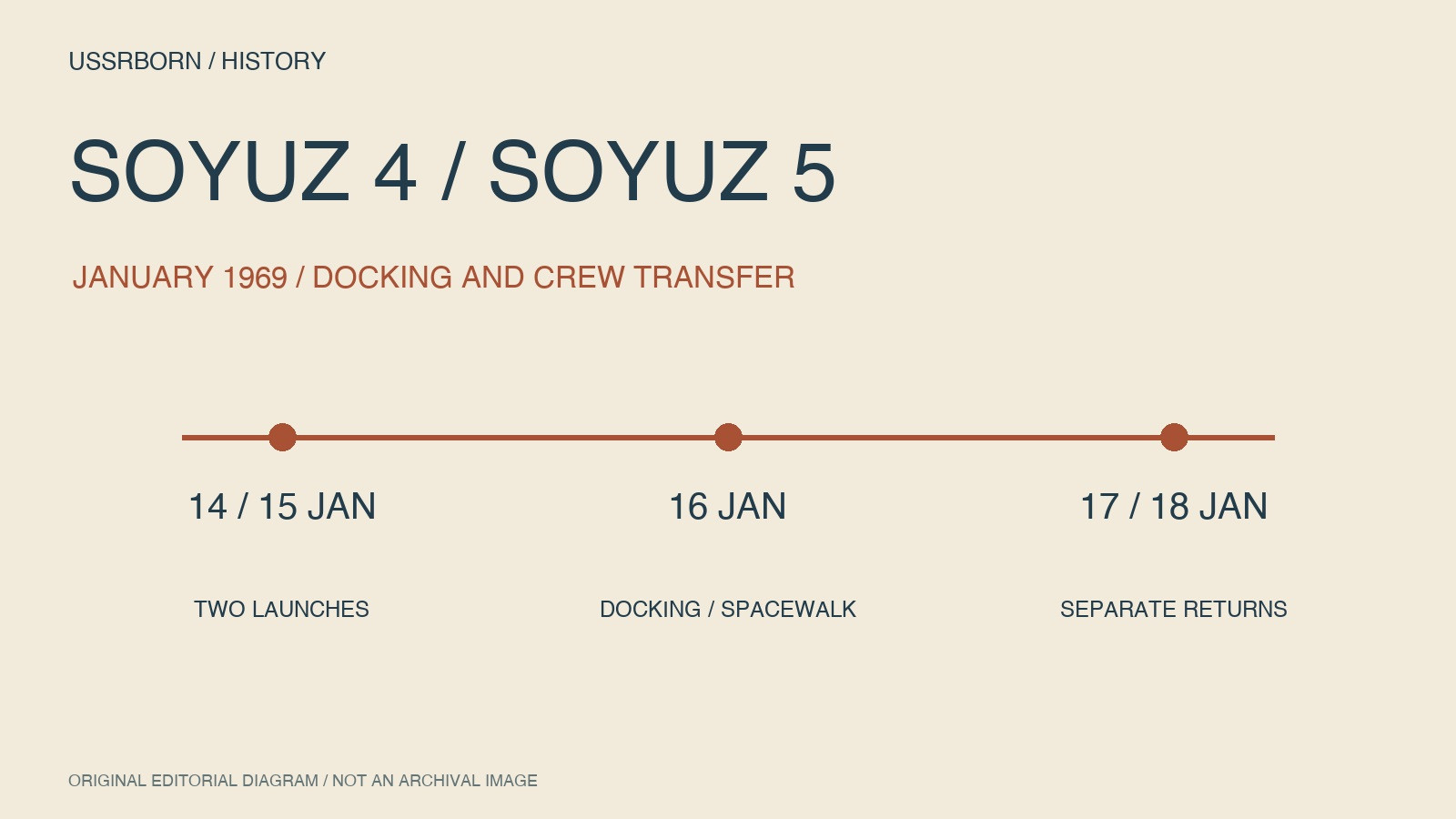
Soyuz 4 launched on 14 January 1969 with Vladimir Shatalov aboard. Soyuz 5 followed the next day, commanded by Boris Volynov and carrying Khrunov and Yeliseyev as well.
The unequal distribution was part of the plan. One spacecraft launched with one person, the other with three. After the orbital meeting, two cosmonauts were to change vehicles. Describing Soyuz 4 as a one-person launch therefore does not describe its entire flight: it returned with three people.
NASA's Mir Hardware Heritage reference separates launch crews from landing crews. That simple distinction is especially useful here. A list of everyone involved in the joint mission does not tell us who occupied each spacecraft at each stage, or which capsule brought a particular cosmonaut home.
Rendezvous was not the same as docking
The spacecraft met on 16 January, with Soyuz 4 taking the active role. The Russian State Archive of Scientific and Technical Documentation, RGANTD, describes automatic rendezvous followed by Shatalov's manual control during the final approach and docking.
An orbital meeting involves several different achievements. The spacecraft must first reach a suitable relative position and motion. They must then approach safely. Finally, the docking mechanism has to join the two structures. Completing one part of that sequence does not automatically complete the next.
This also explains why the historical claim needs careful wording. Uncrewed Soviet spacecraft had already docked automatically. NASA's reference describes the April 1968 flight of Cosmos 212 and Cosmos 213, for example. The January 1969 milestone was the joining of two spacecraft that both carried people, not the first docking of any kind.
Why the transfer required a spacewalk
The docking arrangement on these Soyuz vehicles provided a mechanical connection without an internal passage for the crew. The familiar image of an astronaut opening a hatch and floating into an adjoining spacecraft does not apply to this mission.
Yeliseyev and Khrunov used Yastreb spacesuits to make the external transfer to Soyuz 4. Volynov remained in Soyuz 5, while Shatalov received the two arrivals in the other vehicle. The spacecraft were connected, but each retained its own role in bringing people back to Earth.
Docking and an internal transfer tunnel are therefore separate capabilities. Two structures can be joined for a shared task while their occupants remain separated by the design of the vehicles. The spacewalk was the intended transfer method for this flight, rather than an improvised substitute for a passage that had failed.
That distinction makes the achievement easier to appreciate. The mission did not merely prove that two mechanisms could engage. It required people to move between the vehicles under the conditions for which their equipment and training had prepared them.
Preparation for operations outside the cabin
RGANTD's account describes preparation using docking simulators, pressure-chamber work and Tu-104 flights to practise actions in weightlessness. The archival record places the short orbital episode within a longer programme of rehearsing particular tasks.
The activities also had to form a workable sequence. A successful docking would not, by itself, complete the mission if the crew could not prepare for the exit, carry out the transfer and finish the operation. Equipment and human procedures had to work together.
NASA's historical reference treats the flight as a test of rendezvous, docking and extravehicular activity with implications for the Soviet crewed lunar programme. That does not mean the two spacecraft travelled to the Moon. Their work took place in Earth orbit, where operations relevant to more complex expeditions could be tested.
The distinction between the test location and its possible applications is useful. An Earth-orbit mission could contribute to planning for a different destination without becoming a lunar flight itself.
Different crews came home
The spacecraft remained joined for more than four hours. Published chronologies give slightly different durations, but the operational scale is clear: this was a short joint phase, not months of continuous occupation of a station.
Soyuz 4 landed on 17 January with Shatalov, Khrunov and Yeliseyev. Soyuz 5 returned on 18 January with Volynov. Two members of the joint mission thus launched in one spacecraft and completed their spaceflight in another.
Accounts described the docked pair as an experimental orbital station. The phrase conveyed the possibility of assembling a complex in space, but it should not erase the difference between this temporary combination and later long-duration stations such as Salyut. Two joined transport spacecraft were carrying out a particular experiment.
The lasting significance of the January 1969 mission lies in that complete operational chain. Rendezvous created the opportunity to meet; docking joined the vehicles; a spacewalk allowed people to change spacecraft; and the altered crews then returned separately. An orbital journey no longer had to mean remaining in the vehicle in which a cosmonaut had left Earth.