Medal for the Defence of Leningrad: Origins, Changes and Records
Who qualified for the medal, how participation was documented and why the 1942 specification differs from the familiar brass award.
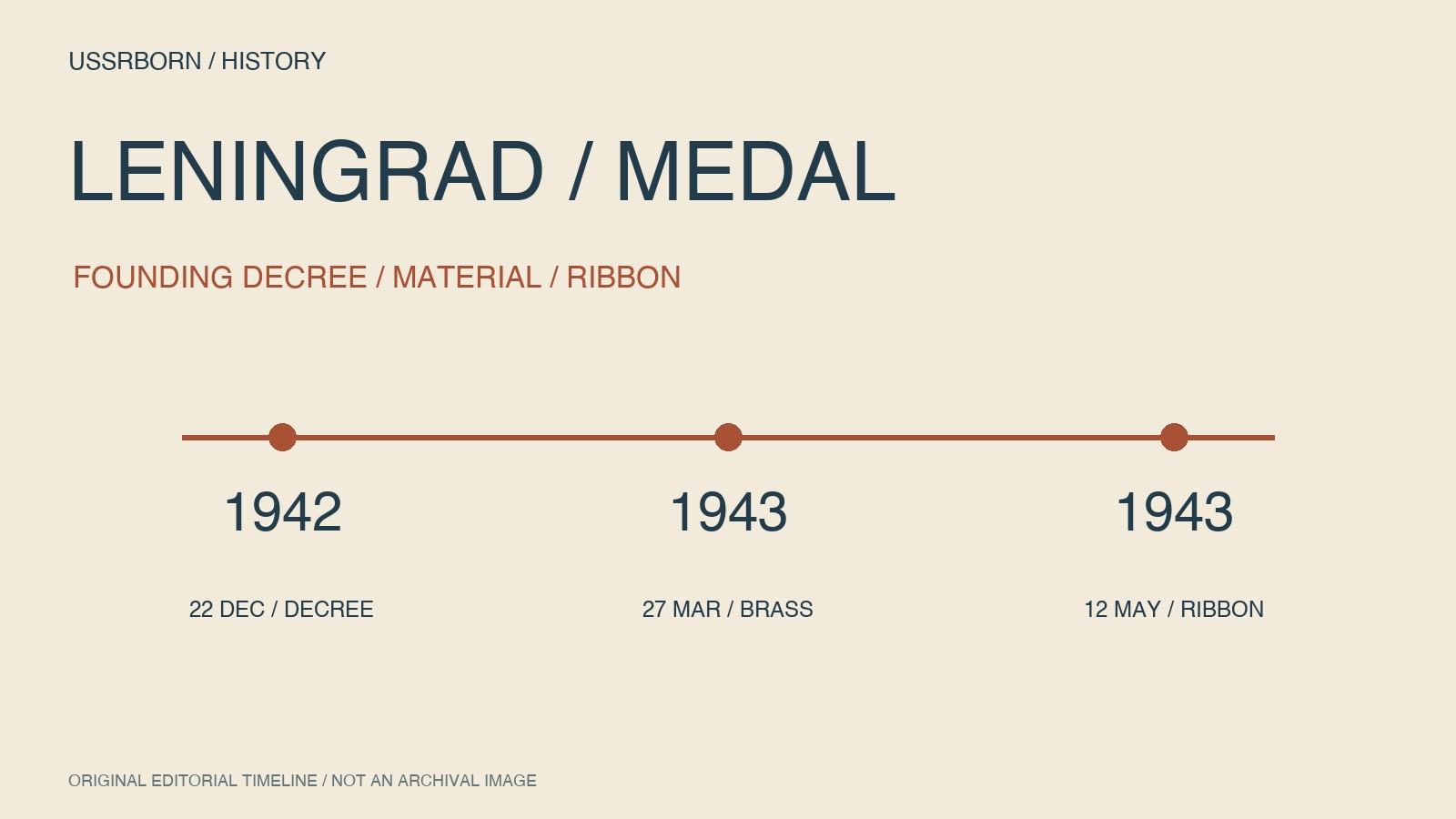
The Medal for the Defence of Leningrad was established on 22 December 1942, while the defence of the city was still continuing. Its history connects military service, civilian participation and the documents needed to recognise that participation. Its familiar appearance also developed in stages: the original specification differed from the material and ribbon adopted in 1943.
What the December 1942 decree established
The Presidium of the Supreme Soviet created four defence medals together, for Leningrad, Odessa, Sevastopol and Stalingrad. Pravda published the decree, regulations and descriptions on 24 December. The Leningrad medal therefore began as a wartime award, rather than a commemorative badge introduced for a later anniversary.
The regulations covered members of the Red Army, Navy and NKVD troops, alongside civilians who had directly participated in the defence. Military status was consequently not the only route to eligibility. At the same time, residence in the city was not a substitute for the condition of participation stated in the regulations.
This distinction matters when reconstructing a family history. An evacuation record, an account of life during the siege and an award document may concern the same person, but they establish different things. The medal recognised participation in the defence. To identify the particular grounds for an individual's award, the relevant personal records are more informative than a general description of the medal.
How participation became an award
Medals were presented on behalf of the Presidium of the Supreme Soviet. The process depended on documents confirming actual participation. These could be issued by military unit commanders, heads of military medical institutions and the relevant regional and city Soviets.
The presentation procedure varied with the recipient's circumstances. Personnel still serving received the award through their unit commanders. Those who had left the army or navy were directed to military commissariats where they lived. Civilian presentations passed through the relevant Soviets. The original scheme therefore helps explain why records of the same decoration may be distributed between different institutions.
Several stages should be kept separate: establishing participation, recording the award decision and presenting the medal. A date on a list or presentation act need not be the date of the work or service being recognised. Nor should a later presentation automatically be moved back to the day on which the medal was established. The institution of an award and its delivery to a particular recipient are different events.
Steel in the original description, brass in production
The description printed in December specified stainless steel and a diameter of 32 millimetres. The obverse showed defenders, including male and female workers, with the Admiralty building in the background. The inclusion of civilian figures matched the breadth of participation recognised in the regulations.
An account by L. N. Tokar published by the museum of St Petersburg Polytechnic University traces subsequent changes. N. I. Moskalyov produced the selected design. On 27 March 1943, brass replaced steel because the original material caused manufacturing difficulties. On 12 May, an olive ribbon with a central green stripe was adopted.
The founding decree and the version established in production should therefore not be compressed into a single specification dated December 1942. A modern reference describing a brass medal with an olive ribbon can accurately describe the familiar award without reproducing the original wording. A careful family caption can distinguish the date the medal was created from the features of the particular object being photographed.
Reading the object alongside its paperwork
The medal itself shows the design and features of manufacture. A certificate associates the award with a name. A nomination list, decision or presentation act can reveal more about the administrative process. These sources complement one another; a photograph of the decoration alone cannot supply an entire service biography.
The Presidential Library catalogues an original copy of the regulations dated 22 December 1942 bearing A. F. Gorkin's autograph. Its archival reference is State Archive of the Russian Federation, fond R-7523, inventory 4, file 115, folios 11-12. This identifies a normative document. It is evidence for the award's rules, not an individual entry for every person who received it.
The Russian Historical Society also describes a St Petersburg digital resource containing civilian award lists, executive committee decisions and presentation acts, mainly drawn from the city's Central State Archive. That stated coverage is important: it should not be mistaken for a complete list of all military and civilian recipients. Failure to find a name in a particular collection does not, by itself, disprove an award.
For a family archive, useful first steps are to preserve images of both sides of the certificate and record names, stamps and dates exactly. These details can then be compared with information about service or employment. A matching surname is a starting point, not sufficient identification. Additional biographical details are needed before treating an entry as belonging to a relative.
The same caution applies to dates. A certificate may document a presentation after the period it recognises. That is not automatically a contradiction. The question is what each document records, rather than whether every surviving date is identical.
A shared award for a defended city
The medal brought military and civilian participation under one set of regulations. Its imagery and its stated eligibility belonged to the same conception of the defence: the recognised participants were not limited to a single branch of the armed forces.
Three processes give the story its structure: the creation of the award in December 1942, changes to its manufacture in 1943 and its presentation to an individual. Keeping them separate makes a general history more accurate and a family account more meaningful. The medal can then be understood both as a state award and as an object whose personal history requires its own evidence.
Related articles
- The siege of Leningrad
- Shostakovich’s Seventh Symphony
- The Order of Glory
- The Medal for Victory over Germany