The Diamond Arm: Script, Production and Theatrical Release
How Gaidai’s comedy developed, why two dates appear, how Gorbunkov’s story works and what the film’s 4K restoration represents.
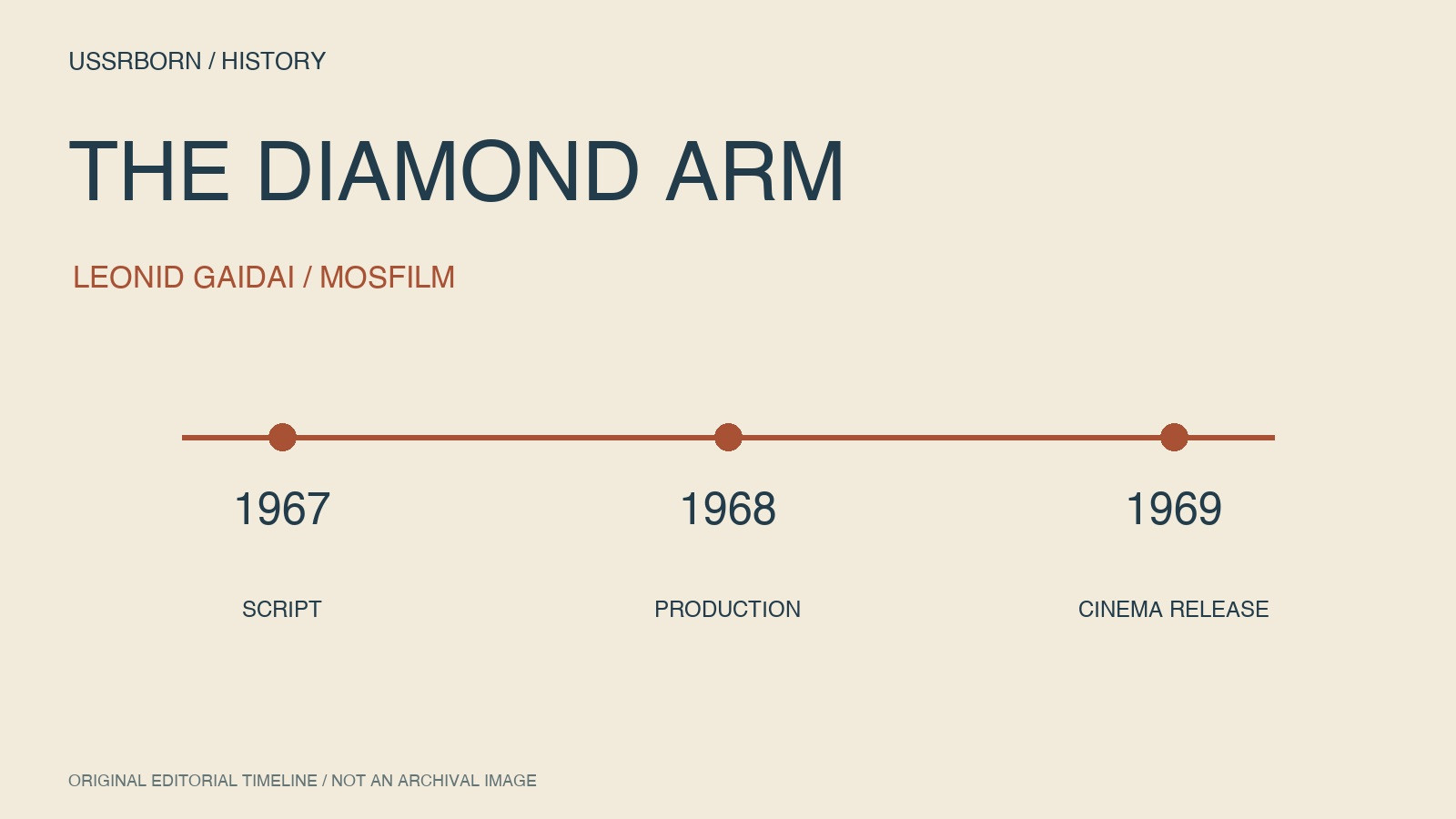
Leonid Gaidai's The Diamond Arm begins with a mistake: an ordinary tourist is taken for a participant in a smuggling operation. The premise turns Semyon Gorbunkov's everyday existence into an adventure for which he is thoroughly unprepared. The film's history connects script development in 1967, production in 1968 and its arrival before a mass cinema audience in April 1969.
Why both 1968 and 1969 appear
Mosfilm's catalogue assigns the film to 1968. A retrospective announcement by the Mosfilm Golden Collection television channel gives 28 April 1969 as its premiere date. The dates refer to different parts of its history: production and its major theatrical launch.
The channel reports more than 76 million viewers during its year of distribution. This conveys the scale of its theatrical audience. It should not automatically be interpreted as an identical number of distinct individuals, since attendance can include repeated visits by the same person.
A useful film caption can preserve both years and explain them. There is no need to treat one as an error or move every stage of production to the premiere date. The chronology becomes clearer when the type of event accompanies the year.
From The Smuggler to Gorbunkov
A Kinopoisk feature based on Mosfilm documents and surviving production objects describes Yakov Kostyukovsky and Moris Slobodskoy's 1967 script The Smuggler. Gaidai contributed to its development and became a co-writer. Yuri Nikulin was intended for the leading role from the outset.
The archival reconstruction identifies 3 January 1968 as the project's launch and 25 April as the first day of filming. It also records changes to the conception: the central character initially had another surname, while the number of criminals and the house manager's role were discussed and reduced.
These details reveal a process of selection. The idea of jewels hidden inside a plaster cast does not, on its own, determine a character, the rhythm of scenes or relationships between people. A premise has to become a film through further decisions. The surviving development record makes that work more visible.
An ordinary man inside a detective adventure
Mosfilm's synopsis describes Gorbunkov as a modest employee who becomes entangled in transporting jewels during a foreign trip and subsequently helps the police expose the crime. Nikulin plays him, with Andrei Mironov, Anatoly Papanov, Nina Grebeshkova and Nonna Mordyukova among the principal performers.
One way to understand the comedy is through the mismatch between a person and the role imposed on him. A detective adventure invites the expectation of someone able to conceal intentions, deceive opponents and act confidently in danger. Instead, its centre is occupied by a man formed by ordinary family life. The more elaborate the criminal design, the more conspicuous the mismatch becomes.
Gorbunkov nevertheless does not remain simply an object of other people's actions. His assistance in solving the crime changes his position. An accidental participant becomes someone accepting a risk deliberately. The structure permits sympathy alongside laughter without requiring him to turn into an invulnerable professional detective.
The contrast gives the premise room to develop. A misunderstanding can initiate a story, but a character's response determines whether it becomes more than a chain of accidents. Here the ordinary person's involvement supplies that connection.
Everyday life as a second system of explanations
The smuggling plot could belong to many adventure stories. What gives this one its particular possibilities is its collision with familiar daily life. Family relationships and social scrutiny provide explanations for behaviour that do not match the criminals' interpretation.
The same action can consequently mean different things to different observers. Within a secret operation it may concern danger; from outside it may look like unusual behaviour by an otherwise ordinary neighbour. That incompatibility can generate comedy without constantly introducing a new criminal scheme.
This is an interpretation of the story's construction, not a claim that it documents every Soviet household. Fiction selects and intensifies aspects of its setting. Recognition can come from exaggeration rather than literal accuracy.
It also explains why viewing a comedy as a social document requires care. A familiar character type is evidence of the film's chosen representation. It is not a statistical description of an entire society. The distinction leaves room to discuss the setting without treating every joke as a factual survey.
A collaborative screen production
The screenplay credits bring together Gaidai, Kostyukovsky and Slobodskoy. Igor Chernykh was the cinematographer, Feliks Yasyukevich the production designer and Aleksandr Zatsepin the composer. The credits place the director and performers within a wider creative team.
Images, clothes, space and music all help viewers interpret a situation. A comic effect depends on more than the words spoken. Reactions, the arrangement of people and transitions between scenes contribute to how it unfolds. Knowing a collection of memorable lines is therefore different from experiencing the whole film.
This is particularly relevant to a work frequently remembered through fragments. A line can survive independently, while the original scene also contains timing and visual information. Looking at the complete sequence restores those relationships.
What the 2024 restoration represents
Mosfilm lists 2024 as the restoration year. The announcement of the theatrical return describes frame-by-frame restoration and a 4K version. This is a new stage in preserving and presenting an existing film, rather than the production date of a new Gaidai comedy.
The studio's restoration service explains that digital work can address scratches, dirt, local light damage and instability in the image. The Diamond Arm appears in its portfolio. That description distinguishes the treatment of surviving material from filming the story again.
The film thus has several connected histories: script development, production, initial distribution and presentation in restored form. Each asks a different question about how the story emerged, how it was made, how audiences encountered it and how its images are preserved. Together they explain its journey more fully than a single date or a selection of famous lines.