The T-34 tank: a legend of the Great Patriotic War
The T-34 is a symbol of victory and one of the most influential tanks in history. What made it good, where it fell short of German machines, and why its mass production decided everything.
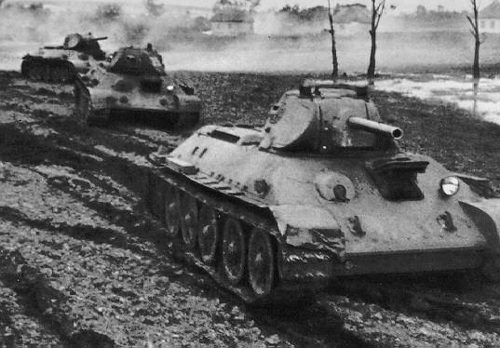
The tank that became a legend
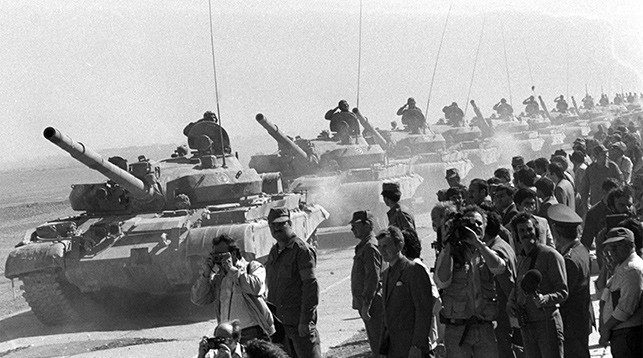
The T-34 was a Soviet medium tank, one of the most famous tanks in history. It became a symbol of victory in the Great Patriotic War and had an enormous influence on tank design worldwide.
When the T-34 appeared, it combined what other tanks usually offered only separately: a good gun, solid protection and high mobility — while also being simple and cheap to mass-produce.
How it was created
Development began in 1937 in Kharkov, at a locomotive factory. The design team was led by Mikhail Koshkin — a man who, according to a well-known story, had worked as a confectioner before his engineering career.
Border battles with Japan and the failures of the Winter War with Finland exposed the weaknesses of the older Soviet tanks. Koshkin persuaded Stalin to fund a new, better-protected "universal tank." This produced the T-34, accepted for production in 1940. Koshkin himself soon died of pneumonia — the illness worsened after a long test drive from Kharkov to Moscow. Alexander Morozov became chief designer.
What made it good
- Sloped armour. The plates were set at a steep angle (up to 60°) — shells were more likely to ricochet, and the protection worked more effectively.
- A 76.2 mm gun — powerful by the standards of the time.
- A diesel engine — less prone to fire than a petrol one, and with good range.
- Wide tracks and suspension — excellent mobility over mud and snow.
- Simplicity. The welded hull could be assembled even by inexperienced workers.
When Germany invaded the USSR in the summer of 1941, the T-34 proved better than the German tanks of that period and gave the enemy an unpleasant surprise — German generals spoke of it with respect.
Weak points — and its main strength
The tank also had drawbacks: a cramped fighting compartment, poor visibility, and at first a radio only on the commander's vehicles. In one-on-one duels the later German "Tigers" and "Panthers" outmatched it in armour and gun.
But the T-34's real strength lay elsewhere — in numbers. By 1942 around 1,200 were being produced each month; for comparison, roughly the same number of "Tigers" were built in the entire war. The tank was cheap, simple and constantly improved. In all, more than 80,000 T-34s of all variants were built during and after the war — the most-produced tank of the Second World War.
Was it the best tank of the war?
Historians disagree. By the raw figures of armour and firepower the T-34 was not the best — the German heavy tanks were stronger in a one-on-one fight. But it was precisely the combination of a "good enough" tank and vast production that proved decisive. As it is often put: it lost on quality, but quantity and reliability won.
In 1944 the T-34-85 appeared — with a more powerful 85 mm gun and reinforced armour. This machine stayed in service for a long time: it was used in Korea, in the Middle East and even in the wars in the former Yugoslavia in the 1990s. The T-34 served in about thirty countries.
Related
- Joseph Stalin — the industrialization of the 1930s built the factories that could turn out the T-34 by the tens of thousands.
- The Great Patriotic War — the war it came to symbolize.
- The Battle of Stalingrad — the battle where it decided the counterblows.
- The Battle of Kursk — its supreme test against Tigers and Panthers.
Sources
The facts in this article can be verified against these sources:
- Wikipedia, "T-34": https://en.wikipedia.org/wiki/T-34
- World War II Database, "T-34 Medium Tank": https://ww2db.com/vehicle_spec.php?q=177
- Discovery UK, "The T-34 Tank: Soviet Armour That Changed WWII": https://www.discoveryuk.com/military-history/the-t-34-tank-soviet-armour-that-changed-wwii/
- HowStuffWorks, "T-34 Medium Tank": https://science.howstuffworks.com/t-34-medium-tank.htm
Where historians disagree (whether it was the "best tank of the war"), we give both positions.