The Soviet Presidency: The March 1990 Law and Gorbachev’s Election
Why Congress elected the first Soviet president, the powers granted on 14 March 1990 and how the revised Article 6 changed the Communist Party’s position.
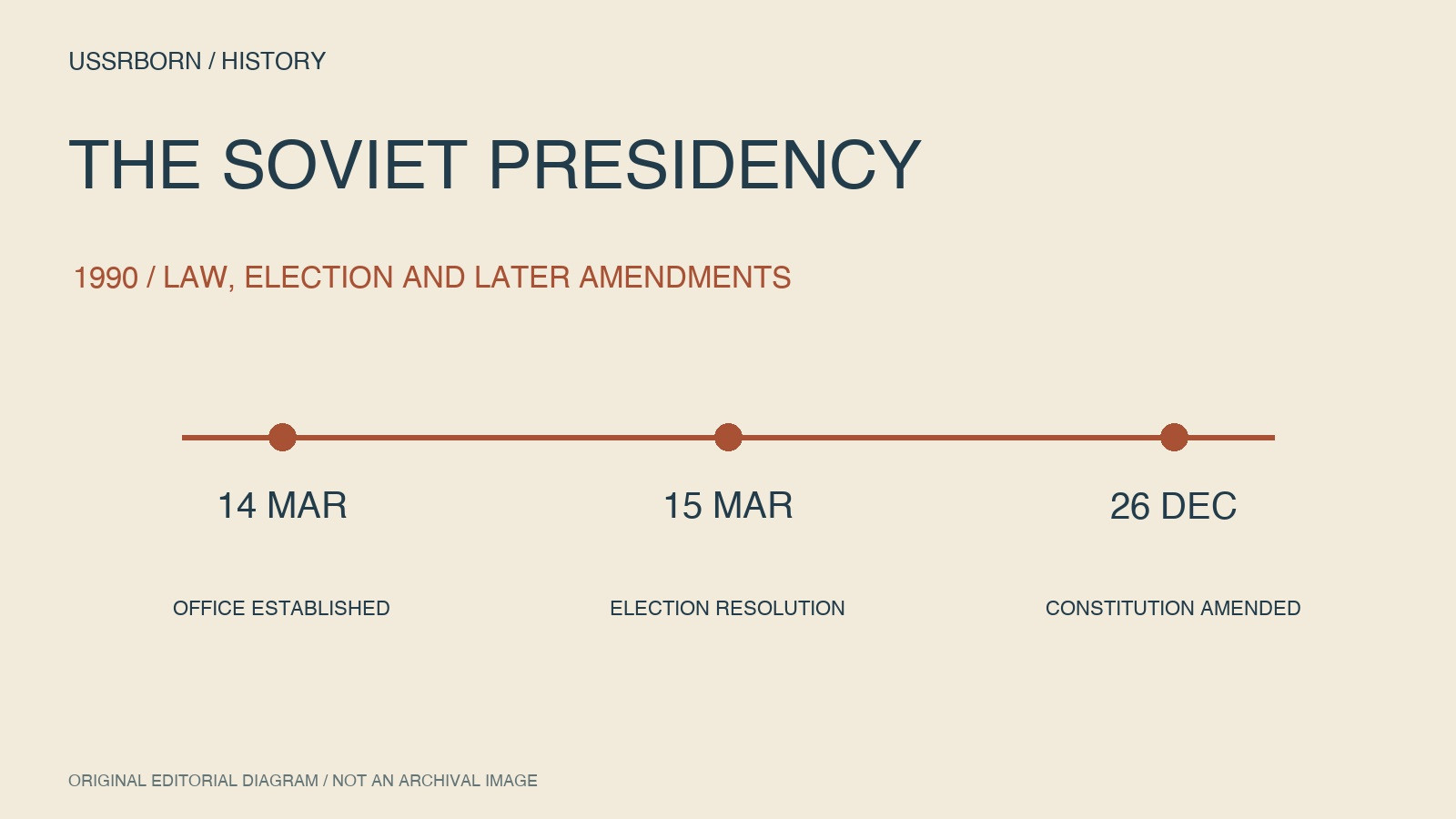
The office of President of the USSR was created on 14 March 1990. The following day, a resolution of the Congress of People's Deputies formalised Mikhail Gorbachev's election. These dates refer to different actions: legislation first established the office and its powers, and the Congress then recorded the election of its holder. The presidency was part of constitutional restructuring, not simply a new name for the Communist Party's general secretary.
The law of 14 March
Law No. 1360-I added Chapter 15.1 to the Soviet Constitution and designated the president as head of state. It expressly stated that creating the office did not itself change the legal position or restrict the constitutionally established competence of the union and autonomous republics.
The same law revised other constitutional provisions. Particularly significant was the new Article 6. Instead of the previous provision establishing the Communist Party's leading role, it described participation by the Communist Party, other parties, public organisations and mass movements in policymaking and administration. The familiar phrase “abolition of Article 6” therefore needs qualification. The article was rewritten, removing its earlier formula of party primacy, rather than simply deleted.
This did not mean that the separation of party and state authority was completed in a day. Legislation supplied a new institutional design; its political effect depended on people, organisations and subsequent decisions. Gorbachev's memoirs linked the presidency to the need to reconstruct the highest level of government. That is the explanation of a participant, not a neutral settlement of every historical debate.
Why the Congress elected the first president
The general rule in Article 127.1 provided for universal, equal and direct elections by secret ballot. The term was five years. Candidates had to be Soviet citizens aged between thirty-five and sixty-five, and one person could serve no more than two terms.
Section III of the same law, however, established a special procedure for the first president. The Congress of People's Deputies would elect that president for five years. Election required more than half the votes of the total number of deputies. The difference between the general principle of direct election and Gorbachev's election by Congress was therefore an express exception in the founding legislation.
The Gorbachev Foundation gives the secret-ballot result as 1,329 votes in favour and 495 against. Resolution No. 1362-I of 15 March 1990 formalised Gorbachev's election. These were deputies' votes, not the result of a nationwide popular election. Under the law, the successful candidate entered office upon taking the oath.
Presidential powers and their limits
In the March version, the president represented the USSR domestically and internationally, acted as guarantor of the Constitution, laws, rights and freedoms, and coordinated the highest state bodies. The office included proposing candidates for senior posts, a role in forming the government, international negotiations and supreme command of the armed forces.
The president signed laws and could return legislation to the Supreme Soviet with objections within two weeks. This was not an unlimited power to block a law permanently. If each chamber reaffirmed the measure by a two-thirds majority, the president had to sign it. Powers were thus accompanied by procedures governing relations with other institutions.
Presidential decrees were binding across the country but had to be issued on the basis of, and to implement, the Constitution and legislation. The office was not a licence to replace the constitutional order at will.
Congress and the new councils
The initial design included a Federation Council chaired by the president and a Presidential Council. The first connected the union centre with the republics' senior officeholders. The second was intended to develop measures concerning major policy directions and national security; its members were appointed by the president.
Congress retained a distinct role. It could remove a president for violating the Constitution or laws with at least two-thirds of the total number of deputies, taking into account the Constitutional Supervision Committee's conclusion. Establishing a presidency therefore did not eliminate Congress or the Supreme Soviet.
March and December were different arrangements
The institutional design soon changed. Law No. 1861-I of 26 December 1990 introduced the constitutional office of vice-president, altered the government's position and provided for a Cabinet of Ministers. It removed the earlier constitutional provisions concerning the Presidential Council and gave the Federation Council a separate chapter.
Reading these December changes back into March produces a structure that did not yet exist when the presidency was created. The documents are more informative when their dates remain visible: the March law established the institution, a special election procedure supplied its first holder, and later amendments reshaped its relationship with other state bodies.