Vladimir Vysotsky: the voice of an era, with a seven-string guitar
A poet, singer and actor called "the voice of the heart of a nation." How Vysotsky became a nationwide idol even though the authorities barely recognized him in his lifetime.
The voice of an era
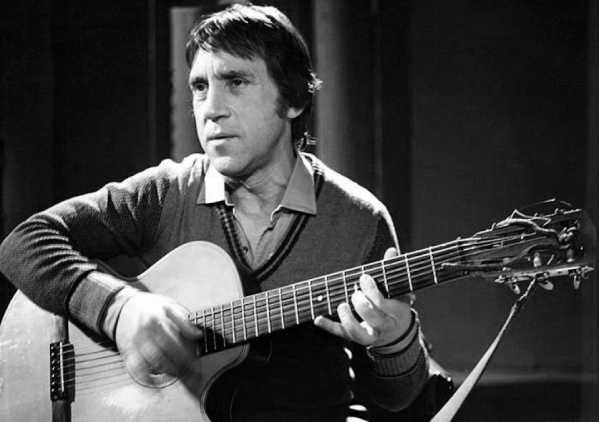
Vladimir Vysotsky was a poet, singer and actor who was called "the voice of the heart of a nation." A hoarse voice over a seven-string guitar, songs about things one was not supposed to say aloud — and a nationwide love that no censorship could stop. He is often compared to Bob Dylan; but for millions of people in the USSR he was something more.
Officially he was barely recognized: his records were not released and his poems were not printed. And yet the whole country knew his songs.
The beginning
Vladimir Semyonovich Vysotsky was born on 25 January 1938 in Moscow. He spent part of his childhood with his military father in Germany, and on returning he entered the Moscow Art Theatre Studio School, graduating in 1960 to become an actor.
The Taganka Theatre
From 1964 almost to the end of his life, Vysotsky performed at Moscow's Taganka Theatre — the famous avant-garde theatre of Yuri Lyubimov. His signature role was Hamlet (1971): in Lyubimov's production the prince appeared as a lone thinker rising up against a cruel state machine. The role became legendary.
Songs the whole country sang
From the early 1960s Vysotsky wrote and sang his own songs to the guitar. He disliked being called a "bard" — he thought of himself first of all as an actor and a poet. In his songs he spoke in the voices of all kinds of people: front-line soldiers, convicts, sailors, athletes, ordinary workers — and through these "masks" he told of real, unvarnished life: the unheroic side of war, the camps, drinking, and the absurdity and hypocrisy of Soviet daily life.
These songs had no official path to listeners. They were recorded on tape recorders and copied from reel to reel — and so they spread across the whole country. Marina Vlady recalled that on a summer evening his voice sounded from literally every open window.
Film
Vysotsky acted in films too. His best-known role was Gleb Zheglov in the TV film "The Meeting Place Cannot Be Changed" — still remembered and loved today. In all he appeared in dozens of films and plays.
Marina Vlady
In 1970 Vysotsky married the French actress of Russian descent Marina Vlady. Their romance — passionate and "at a distance" — became a legend: she divided her life between France and Moscow, and her position helped Vysotsky travel abroad. He visited France and the United States and performed for audiences abroad.
Strain, breakdowns and an early death
Vysotsky's life was one of burning out. The pressure of the authorities and the bans, the frantic pace of work, and a hard struggle with alcohol and heart disease all wore him down.
He died on 25 July 1980, at the age of 42, during the Moscow Olympics. The authorities said almost nothing about his death — only a small notice from the Taganka Theatre appeared. But tens of thousands of people came to say goodbye: Moscow was bidding farewell to its beloved voice.
Legacy
After his death Vysotsky became a genuine cult. His poems and song lyrics began to be officially published only in the late 1980s, during perestroika. An asteroid is named after him, festivals are held in his honour, and his songs are known by heart. In polls of the most beloved compatriots of the 20th century he has repeatedly ranked at the very top — alongside Gagarin. The voice that was kept off the official stage became one of the main voices of the era.
Frequently asked questions
Who was Vladimir Vysotsky? A Soviet poet, singer and actor (1938–1980), a writer of guitar songs and a star of the Taganka Theatre, and an iconic figure of Russian culture.
Why were his songs banned? The authorities considered them too sharp: he sang about forbidden subjects — the camps, war without varnish, hypocrisy. They were barely published officially, but they spread on tape recordings.
How did he die? Of cardiac arrest in 1980, at the age of 42; years of enormous strain and a struggle with addiction took their toll.
Related
- Soviet cinema — the screen on which Vysotsky played his famous roles.
- Shortages and queues — the very daily life he sang about honestly.
- Andrei Sakharov — another man whose voice the authorities tried to silence.
Sources
The facts in this article can be verified against authoritative sources:
- Encyclopædia Britannica, "Vladimir Vysotsky": https://www.britannica.com/biography/Vladimir-Vysotsky
- Wikipedia, "Vladimir Vysotsky": https://en.wikipedia.org/wiki/Vladimir_Vysotsky
- Encyclopedia.com, "Vysotsky, Vladimir": https://www.encyclopedia.com/history/encyclopedias-almanacs-transcripts-and-maps/vysotsky-vladimir
- Seventeen Moments in Soviet History (Michigan State University), "Vladimir Vysotsky": https://soviethistory.msu.edu/1980/vladimir-vysotsky/
- Radio Free Europe / Radio Liberty, "When Legendary Soviet Bard Vladimir Vysotsky Hit Hollywood": https://www.rferl.org/a/vladimir-vysotsky-hollywood-russia-superstar-suspicion/27142717.html