Yuri Gagarin: the first human in space
On 12 April 1961 Yuri Gagarin became the first human in space. His path from a Nazi-occupied village to orbit, a dramatic return, worldwide fame and a mysterious death.
The first human in space
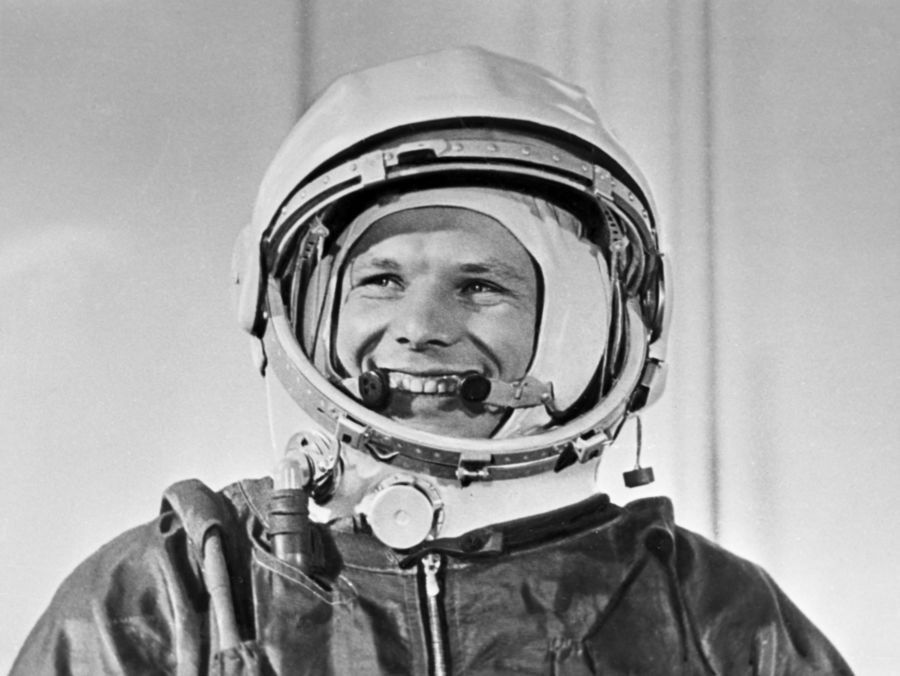
On 12 April 1961 a citizen of the USSR, Yuri Gagarin, became the first human to travel into space. Aboard the spacecraft Vostok 1 he completed one orbit of the Earth — the flight lasted 108 minutes — and returned alive. In those minutes he was transformed from an ordinary pilot into the most famous person on the planet.
It was a triumph of Soviet science and one of the defining moments of the space age. But behind the polished image lay a hard life and mortal danger too, which are worth telling honestly.
A childhood under occupation
Yuri Gagarin was born on 9 March 1934 in the village of Klushino in the Smolensk region, west of Moscow. His family was a simple one: his father, Alexey Ivanovich, worked as a carpenter on a collective farm, and his mother, Anna Timofeyevna, on the farm. Yuri was the third of four children.
His childhood fell during the war. The German occupation reached Klushino too, interrupting his schooling and bringing the family hard trials. Only after liberation was Gagarin able to return to school, finishing seven years of it in 1949.
From the factory to the sky
What followed would later be called symbolic: "from the factory to the stars."
First Gagarin trained as a molder (foundryman) at a trade school near Moscow. Then he entered an industrial college in Saratov — and there he joined a flying club, where he took to the air for the first time. Aviation captured him. In 1955 he entered the military aviation school in Orenburg, graduated in 1957 and became a military fighter pilot. He served in the north, near the border with Norway.
In 1957 Gagarin married Valentina, whom he had met in Moscow. They had two daughters.
Choosing the first
In 1960 the first group of Soviet cosmonauts was selected. Gagarin was immediately among the leaders — together with Gherman Titov.
In the end Gagarin was chosen. His flying skill, his calm character, his famously winning smile and his short stature (the Vostok cabin was very cramped) all played a part. But perhaps the main thing was something else: his biography — the road from a simple village family through a factory to the heights — was seen as the ideal embodiment of the Soviet dream. Titov was named his backup.
The flight of Vostok 1
On the morning of 12 April 1961 Vostok 1 lifted off from the Baikonur Cosmodrome. At the moment of launch Gagarin spoke the word that became famous — "Poyekhali!" ("Let's go!"). Lift-off was at 9:07 Moscow time, and Gagarin's call sign was "Kedr" (Cedar).
The flight was fully automated. Doctors did not know how a human would behave in weightlessness, or whether his mind might fail, so the manual controls were locked — and the code to switch them on, in case of need, was sealed in an envelope on board. Gagarin never opened it. His task was to monitor the systems and report on how he felt.
In 108 minutes Vostok 1 circled the Earth once. Gagarin saw what no one before him had seen: our planet from space. "The Earth is blue... how wonderful," he reported. He described the weightlessness and the sight of the Earth's horizon.
The return: a near-disaster
The most dangerous part turned out to be the return. As the craft left orbit, the equipment module failed to separate on time: a bundle of cables held it joined to the descent module for about ten minutes, and the spacecraft tumbled chaotically as it entered the atmosphere. Fortunately, the parts finally came apart.
Then, following the standard Vostok procedure, Gagarin ejected at an altitude of about 7 kilometres and landed separately from the capsule, by parachute — in the Saratov region, near the Volga, about 300 kilometres from the planned spot. Local people met him.
Here lies a curious detail. Under the rules of the time, for an official aviation record the pilot had to land together with the craft. So the USSR concealed the ejection for years (the truth was only admitted in 1987), and in the official version Gagarin "landed in the spacecraft" and exactly on target.
Beating America
Gagarin beat the Americans. The first US astronaut, Alan Shepard, went into space only 23 days after him — and even then in a short "hop," without reaching orbit. The first American to orbit, John Glenn, did not fly until February 1962 — more than ten months after Gagarin.
This lag stung the US badly. As early as May 1961 President John Kennedy announced that America would set itself the goal of landing a man on the Moon by the end of the decade — and so the Moon race began.
Worldwide fame
Gagarin instantly became a global celebrity. He was awarded the Order of Lenin and given the title Hero of the Soviet Union. The country sent him on "missions of peace" — trips abroad where crowds greeted him. He met world leaders, including Queen Elizabeth II of the United Kingdom and Fidel Castro.
For the USSR, Gagarin became a living symbol of superiority in space — and simply everyone's favourite.
Life after the flight
Fame had its reverse side. The authorities feared losing their national hero and for a long time would not let Gagarin fly again. He became deputy director of the Cosmonaut Training Center, preparing others for their flights. The weight of all that attention was not easy to bear, but by the late 1960s he had returned to work and study.
Gagarin was the backup for the tragic flight of Soyuz 1 (1967), in which his friend, the cosmonaut Vladimir Komarov, died when the parachutes failed to open. In February 1968 Gagarin defended his engineering thesis with honours at a military academy.
Death
On 27 March 1968 Yuri Gagarin died. During a training flight on a MiG-15UTI trainer aircraft, together with the instructor Vladimir Seryogin, their plane crashed near Moscow. Gagarin was only 34.
The exact cause of the crash was classified, and for decades it remained a matter of dispute and theories. One of the best-known explanations is that another aircraft (a Su-15 fighter) passed too close at supersonic speed, and the air wave it raised threw the MiG into a spin from which the pilots could not recover in time. Other causes are named too — for example, a sharp manoeuvre to avoid a weather balloon. There is still no single accepted version.
Gagarin's death shook the country: for the first time in Soviet history mourning was declared for a person who had not been a head of state. His ashes were interred in the Kremlin wall.
Remembrance
Gagarin's name is honoured all over the world. His hometown of Gzhatsk was renamed Gagarin. 12 April became Cosmonautics Day; later the UN declared the date the International Day of Human Space Flight. Around the world it is marked as "Yuri's Night."
Streets, towns, a launch pad at Baikonur and a crater on the Moon are named after him. And during the Apollo 11 mission, American astronauts left on the Moon a memorial to fallen space explorers — Gagarin among them.
Frequently asked questions
When did Gagarin fly into space? On 12 April 1961, aboard the spacecraft Vostok 1.
How long did the flight last? 108 minutes — in that time he completed one orbit of the Earth.
Is it true that he did not land in the capsule? Yes. Gagarin ejected and came down by parachute separately from the craft. The USSR concealed this until 1987, because for an official record the pilot had to land together with the spacecraft.
How did Gagarin die? In 1968, in the crash of a training aircraft. The exact cause is classified and disputed; the most commonly cited explanation is a dangerous close approach by another aircraft whose air wave threw the plane into a spin.
Related
- Sputnik 1: the start of the space age — the first step that opened the road to space.
- Sergei Korolev: the Chief Designer — the man who prepared his flight.
- Valentina Tereshkova: the first woman in space — the next Soviet space record.
- The Cold War: half a century of confrontation — the rivalry of which the space race was a part.
- Laika: the first living creature in orbit — the four-legged forerunner of his flight.
Sources
The facts in this article can be verified against authoritative sources:
- NASA, "Remembering Yuri Gagarin 50 Years Later": https://www.nasa.gov/history/remembering-yuri-gagarin-50-years-later/
- Encyclopædia Britannica, "Yuri Gagarin": https://www.britannica.com/biography/Yuri-Gagarin
- HISTORY, "What Really Happened to Yuri Gagarin, the First Man in Space?": https://www.history.com/articles/what-really-happened-to-yuri-gagarin-the-first-man-in-space
- Wikipedia, "Yuri Gagarin": https://en.wikipedia.org/wiki/Yuri_Gagarin
- Wikipedia, "Death of Yuri Gagarin": https://en.wikipedia.org/wiki/Death_of_Yuri_Gagarin
Where the data are contested (the cause of his death), we give different versions rather than a single one.