The Suez Crisis of 1956: causes, the war, and the Soviet role
In 1956 Britain, France and Israel invaded Egypt over the Suez Canal — and won the fighting, but were forced to retreat under pressure from the United States and the USSR. How it changed the world.
What the Suez Crisis was
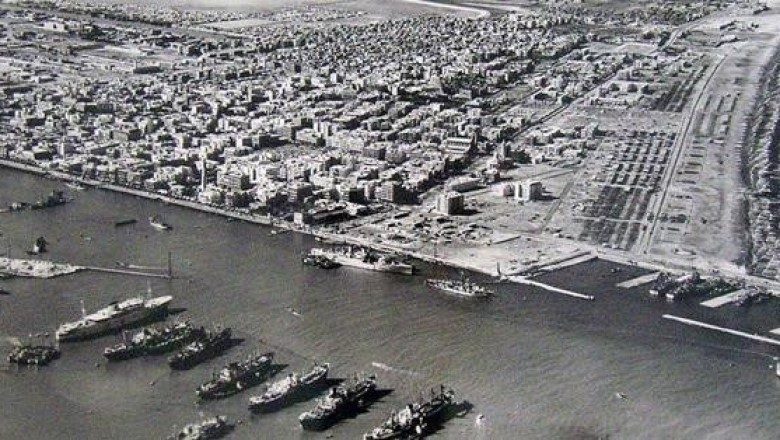
The Suez Crisis of 1956 was an international conflict over the Suez Canal in which Britain, France and Israel attacked Egypt. Militarily the invasion succeeded, but under pressure from both superpowers at once — the United States and the USSR — the coalition had to retreat in humiliation.
The crisis was a turning point of the Cold War. It brought the era of British and French imperial power to an end, showed that the world was now run by two superpowers, and made Egypt's leader Nasser a hero across the Arab world. It also matters for understanding the role of the USSR — a loud one, but, as we shall see, far from the decisive one.
The Suez Canal: why it mattered so much
The Suez Canal, opened in 1869, links the Mediterranean and the Red Sea. It is the shortest sea route between Europe and Asia: without it, ships carrying oil and goods have to sail all the way around Africa. The canal was a vital artery of world trade — and a strategic "chokepoint" to which the Western powers clung.
The canal was run by the Suez Canal Company, controlled by British and French capital. For London and Paris the canal was a symbol of influence and a source of income.
Nasser and the nationalization of the canal
At the centre of the crisis was Egyptian President Gamal Abdel Nasser, a leader of Arab nationalism who sought to end colonial dependence. His main project was the Aswan High Dam on the Nile — the foundation of Egypt's future industrialization.
At first the US and Britain promised to finance the dam. But Egypt was drawing closer to the Soviet bloc (in 1955 it signed an arms deal via Czechoslovakia), and on 19 July 1956 Washington withdrew its offer. In response, on 26 July 1956 Nasser nationalized the Suez Canal: he intended to pay for the dam with the tolls from passing ships. He promised the shareholders compensation.
For Britain and France, this was a direct challenge.
The secret collusion
Behind the scenes, Britain, France and Israel agreed on a joint strike. Each had its own motive: British Prime Minister Anthony Eden saw Nasser as a threat to imperial influence; France was angry at his support for the Algerian rebels; Israel feared Egypt, which was blockading its passage through the Straits of Tiran.
The plan was cunning: Israel would attack Egypt first, and then Britain and France would "intervene" as peacemakers — using that pretext to occupy the canal zone and topple Nasser.
The war
Events moved quickly.
- On 29 October 1956 Israeli forces invaded the Sinai Peninsula and advanced toward the canal, routing the Egyptian units.
- On 31 October Britain and France, having issued an ultimatum, began bombing Egyptian positions.
- On 5–6 November British and French forces landed near Port Said and Port Fuad and began occupying the canal zone.
In purely military terms the operation was going well. But politically it was doomed.
Both superpowers against it
Both superpowers opposed the invasion — and that decided everything.
The United States — the decisive force. President Dwight Eisenhower was furious: his NATO allies had started a war without even warning him. He feared the invasion would push newly decolonizing nations into Moscow's arms. Instead of offering support, Eisenhower used an economic weapon: he threatened to sell off America's holdings of British pound bonds, which would have collapsed the pound sterling. Faced with financial catastrophe, Britain agreed to a ceasefire almost at once.
The USSR — loud, but secondary. Soviet leader Nikita Khrushchev angrily condemned the aggression and threatened to rain missiles down on London and Paris. It sounded terrifying — but it was largely rhetoric. In those very days the USSR was itself crushing the uprising in Hungary and had no intention of going to war over Egypt; Eisenhower even warned Moscow against reckless talk of a nuclear strike. What really stopped the coalition was not Soviet bluster but American money.
Retreat and the first UN peacekeepers
The ceasefire came into effect on the night of 6–7 November 1956. To oversee the withdrawal, the UN dispatched a peacekeeping force for the first time in history — the United Nations Emergency Force (UNEF). By 22 December the British and French troops had left Egypt, and the Israelis withdrew from the Sinai by March 1957. The canal then reopened — now under Egyptian control.
Who won and who lost
The outcome of the crisis was paradoxical.
Nasser — the winner. The soldier lost, but the politician won. Egypt was defeated on the battlefield, yet Nasser kept the canal, stood firm against two European empires and became a hero of Arab nationalism. His standing across the Arab world soared.
Britain and France — humiliation and the end of empire. The crisis dealt a crushing blow to their prestige and, in effect, ended their role as great world powers. British Prime Minister Anthony Eden soon resigned.
The US and USSR — a confirmed duopoly. The crisis showed clearly that the fate of the world was now decided by two superpowers, and that even Britain and France could not act without regard for Washington. In January 1957 the US proclaimed the "Eisenhower Doctrine," taking on responsibility for the security of the Middle East.
There was a dark detail too: while the West's attention was fixed on Suez, the USSR crushed the Hungarian uprising unhindered.
The Soviet role: loud, but not decisive
Since the Suez Crisis is often remembered as an episode of the Cold War, it is important to be honest about the details.
The Soviet contribution was real: it armed Egypt, later financed that same Aswan Dam, and Khrushchev's nuclear threats raised Moscow's standing in the Arab countries. But the decisive lever was US financial pressure, not Soviet rhetoric. It was the threat to collapse the pound that forced Britain to retreat within days. Historians largely agree on this. So "the USSR threatened missiles and saved everyone" is a neat myth; the real picture is more complex and more interesting.
Frequently asked questions
What caused the Suez Crisis? The nationalization of the Suez Canal by Egyptian President Nasser on 26 July 1956 — after the US and Britain refused to finance the Aswan High Dam. Britain, France and Israel responded with a secretly prepared invasion.
Who won the Suez Crisis? The coalition won the military campaign, but politically Nasser won: he kept the canal and became a hero of the Arab world, while Britain and France were humiliated.
What role did the USSR play? A loud but not a decisive one. Khrushchev threatened nuclear missiles against Western Europe, but it was US financial pressure that stopped the coalition. The USSR did, however, arm Egypt and later build the Aswan Dam.
Why did the Suez Crisis matter? It marked the end of British and French imperial power, confirmed the dominance of the US and the USSR, produced the "Eisenhower Doctrine," and saw the first UN peacekeeping mission.
Related
- The Cold War: half a century of confrontation — the global context of which Suez was a part.
- The Cuban Missile Crisis of 1962 — another Cold War moment when the world balanced on the edge of nuclear catastrophe.
- The dissolution of the USSR (1991) — how the superpower confrontation ended.
Sources
The facts in this article can be verified against authoritative sources:
- Encyclopædia Britannica, "Suez Crisis": https://www.britannica.com/event/Suez-Crisis
- U.S. Department of State, Office of the Historian, "The Suez Crisis, 1956": https://history.state.gov/milestones/1953-1960/suez
- HISTORY, "Suez Crisis": https://www.history.com/articles/suez-crisis
- Wikipedia, "Suez Crisis": https://en.wikipedia.org/wiki/Suez_Crisis
- Origins (Ohio State University), "The Suez Crisis (1956)": https://origins.osu.edu/milestones/suez-crisis-1956
- National Army Museum, "Suez Crisis": https://www.nam.ac.uk/explore/suez-crisis
Where assessments differ (how much the USSR mattered), we give a balanced picture rather than a single dramatic version.